Galactic Merge Idle
- 3.4
- Rating
- 100.00K
- Installs
- Free
- Price

 Analysis by App-foxy
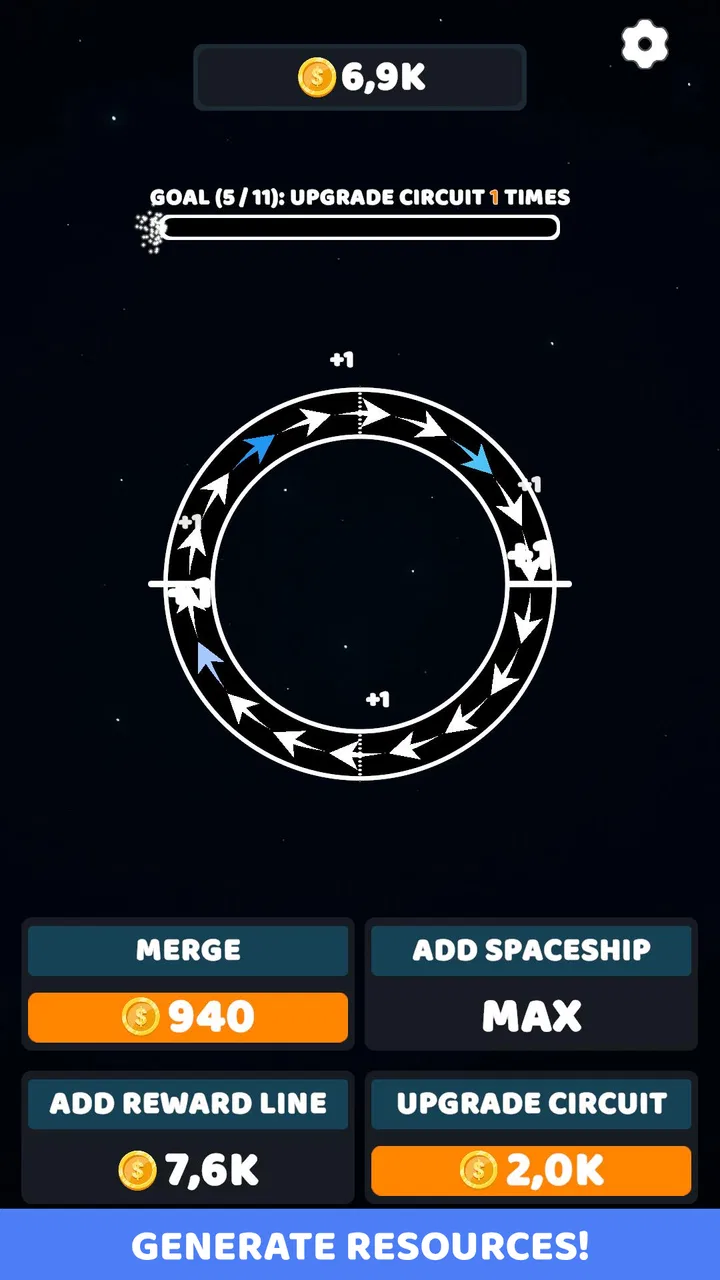
I spent time with Galactic Merge Idle as a compact arcade game built around a simple space-production idea: create ships, combine them, and grow a larger galactic operation. That premise is easy to understand within moments, but the real question is whether the loop gives me enough meaningful progress to keep returning after the first burst of curiosity. My answer is mixed but generally positive. It is a relaxed choice for short sessions, especially when I want something lighter than a demanding action game, although players looking for deep strategy or constant challenge may outgrow it.
VOODOO presents the game as free to play, with an Everyone age rating and support for devices running Android 8.0 or later. It sits firmly in the arcade space rather than trying to be a complex management simulator. The current version is 1.7.2, and the game has passed the early discovery stage with over 50 thousand installs. Its average rating is 3.4, which feels believable for a title whose appeal depends heavily on whether a player enjoys repetitive merging and gradual expansion.
How the early goals shape the first sessions
The opening appeal comes from having a clear objective without a long tutorial burden. I immediately understood that the useful action was not simply collecting ships, but combining them into something more valuable and using that growing production to push the operation forward. That clarity matters on a phone, because I can start a session without first learning a large set of rules or studying a complicated interface.
You May Also Like

 Blood Strike: 2.5 Anniversary
Blood Strike’s Loadouts Turn Every Drop Into a Tactical Gamble
A close look at Blood Strike’s custom loadouts: how fast access to signature weapons reshapes its battle royale rhythm, rewards preparation, and narrows the gap between fights.

 Pandora - Music & Podcasts
Pandora’s Music Is Easy to Start, but Harder to Recover
Pandora’s strength is its low-effort path from a seed to a station. Its weak spot is how much confidence it asks you to place in connection, setup, and quiet recovery.

 8 Ball Pool
 Is Built on Rivalries, Rematches, and Routine
A close look at the rivalries, rematches, shared routines, and unanswered safety questions that turn a quick pool match into a persistent mobile community.

 Samsung Music
’s Quiet Strength Is Playing What You Already Own
Its reach comes less from spectacle than from dependable access to a personal library. That simplicity is both the app’s strongest retention engine and its ceiling.

 AccuWeather: Weather Radar
AccuWeather Review: A Quick, Clear Forecast for Everyday Decisions
For everyday plans, the best forecast is the one you can understand quickly. AccuWeather makes rain timing, radar, and local conditions easy to act on, with a few trade-offs.

 Hill Climb Racing
Why Hill Climb Racing Still Turns Crashes Into One More Run
A tiny car, a bumpy hill and one more upgrade: Hill Climb Racing keeps resurfacing because its simple chaos makes every near-miss feel personal.
More From Our News Desk
View All News


The early game works best when I treat each small improvement as a short-term target. Instead of thinking about the entire galaxy, I focus on the next merge, the next useful ship, or the next expansion step that appears within reach. This creates a comfortable rhythm: make a small decision, watch the production improve, and then decide whether to keep playing or leave the game for a while.
One practical tip is to avoid merging automatically the moment two matching options become available. I found it more useful to look at the surrounding production first. A merge can be satisfying, but rushing every combination may make the board or workflow less flexible if I still need lower-level pieces to reach the next useful arrangement. The game is accessible enough for casual play, yet this small pause gives the loop a little more intention.
The first goals are therefore effective because they are visible and manageable. They do not ask me to commit to a long session. I can open the game while waiting for transport, make a few improvements, and stop without feeling that I abandoned a complicated plan. That makes it a natural fit for people who enjoy incremental progress but do not want a game that demands full attention every time it opens.
At the same time, the simplicity can expose the limits of the opening. Players who expect varied missions, story development, or a wide range of tactical choices may find the first sessions too narrow. The space theme gives the activity a pleasant identity, but the main attraction remains the merge-and-expand cycle rather than exploration in the traditional sense.
What progress feels like in practice
The strongest part of the design is the way progress is presented through visible growth. A newly combined ship or a larger production setup gives me an immediate signal that the previous actions mattered. This is more satisfying than a system where rewards are mostly hidden behind menus, because the result of a decision is easy to recognize while I am still playing.
I also like that the game can serve two different moods. In an active session, I can pay attention to available merges and try to improve the production flow. In a quieter session, I can simply check what has changed and make the most obvious next improvement. That flexibility is valuable for an idle arcade game, since not every player wants to optimize every moment.
However, visible progress is not the same as deep progress. After the initial excitement, the question becomes whether each new step changes how I play or merely increases the scale of the same activity. Galactic Merge Idle is at its best when a new improvement gives me a fresh decision to make. It is less compelling when the reward feels like another number or another visual upgrade without a meaningful change in priorities.
For everyday use, I would place it in the same category as a small routine rather than a main gaming appointment. I might open it during a coffee break, make a few merges, check whether the next expansion is realistic, and close it before the session becomes repetitive. That pattern suits the game better than expecting it to carry a long evening of uninterrupted play.
A useful way to keep the experience from becoming passive is to set a personal stopping point. I might decide to play until the next ship combination or until one production improvement is completed, rather than leaving the game open indefinitely. This turns the idle structure into a series of small goals and helps me notice whether the current stage is still enjoyable or has become routine.
Where the difficulty and pacing begin to change
The difficulty curve is gentle at first. The basic actions are easy to read, and the early rewards arrive often enough to make the system feel responsive. That is appropriate for an arcade game aimed at quick understanding. I never felt that the game was trying to defeat me before I had learned its central loop.
The challenge is more about patience and prioritization than reflexes. As progress continues, the value of a decision depends increasingly on when I make it and whether I am prepared to wait for the next improvement. That can be relaxing, but it also means the sense of challenge may become uneven. A player who enjoys planning will find small choices to think about, while someone who wants increasingly intense action may feel the pace flatten.
This is where the game differs from a conventional arcade alternative. A fast arcade title usually tests timing, movement, or reaction speed, with failure arriving quickly and success depending on execution. Here, the pressure is softer. The reward comes from arranging progress over time, and the satisfaction is closer to watching a small operation become more productive than mastering a difficult level.
Compared with a traditional idle game, the merging gives the player a more tangible action to perform. I am not only waiting for a resource to accumulate; I am also deciding how to turn available ships into better production. That extra interaction helps the game feel less like a passive timer, though it does not completely remove the repetition that comes with the genre.
Players should also understand what kind of challenge they are not getting. This is not the right choice if I want precise controls, competitive matches, complex resource chains, or a strong narrative reason to continue. A puzzle game may offer more demanding problem solving, while an action arcade game may provide more immediate excitement. Galactic Merge Idle is aimed at the quieter middle ground between those experiences.
My advice is to treat the pacing as a feature rather than a problem if I enjoy gradual improvement. I should not approach it expecting every session to introduce a dramatic twist. The better question is whether the next small upgrade feels worth pursuing. When it does, the game is pleasantly calming. When it does not, continuing usually adds repetition rather than discovery.
Retention, spending pressure, and the long-term fit
The retention design depends mainly on the appeal of returning to an unfinished production cycle. I understand why that can be effective: a partially developed space operation creates a small reason to check back, and the possibility of another merge gives the next session a clear starting point. This is a familiar idle-game motivation, but the space setting makes the routine feel more playful than a purely abstract progress meter.
Still, the same structure can create pressure if I begin to measure enjoyment only by how quickly I advance. The game is free to download and play, but it includes optional purchases priced from $1.99 to $49.99 per item. That range is important to keep in mind before starting. I can enjoy the basic loop without spending, yet players who dislike seeing purchasable accelerators or premium options in a progression-focused game should approach it cautiously.
I prefer to decide in advance whether I am playing for relaxation or optimization. If I am relaxing, I can accept slower progress and use the game in short visits. If I am optimizing, the presence of purchases can make every delay feel like an obstacle rather than part of the design. That distinction is one of the most useful things to recognize before committing to the game for the long term.
Another practical habit is to compare the satisfaction of an upgrade with the time spent waiting for it. If a new ship or expansion changes my choices, the wait can feel worthwhile. If it only gives me a larger version of the same production loop, I would rather close the game and return later. This helps prevent the idle format from turning into background tapping without a clear personal goal.
The game is also better suited to players who enjoy self-directed goals than to people who need a strong campaign structure. I can create my own milestones, such as reaching a particular production stage or completing a sequence of merges, but the motivation comes from the system itself. Someone who wants chapters, characters, or a defined ending will probably find more satisfaction in another arcade or simulation game.
Its Everyone rating makes it approachable for a broad audience, and the controls and concept are easy to explain to someone who has not played many mobile games. I could recommend it to a casual player who likes space themes and incremental upgrades. I would be more selective with a child, however, because the free-to-play format and in-app purchase range are worth discussing before handing over a device.
The rating of 3.4 from around 383 ratings suggests that the experience does not work equally well for everyone. I would not treat that number as a verdict by itself, but it matches my impression that the game has a clear audience and clear boundaries. People who enjoy merging and idle growth may find it pleasant, while those expecting richer content may lose interest quickly.
Small decisions that make the loop more enjoyable
The first is to keep the production area readable instead of filling it with every possible option immediately. When I leave room to see what is available, the next merge is easier to identify and the game feels less cluttered. This is especially useful during short sessions, when I do not want to spend more time interpreting the screen than making progress.
The second is to distinguish between a satisfying merge and a useful merge. A larger ship may look like the obvious choice, but the better decision depends on what I am trying to build next. I get more value from considering the next two steps than from reacting only to the reward directly in front of me. That forward look is where the game offers its most interesting layer of judgment.
The third is to use idle progress as a reason to return, not as a reason to keep the game open constantly. The experience feels healthier when I check in at natural breaks instead of treating it like a task that must be monitored. This also makes each return feel more rewarding, because I have had time away from the visual repetition.
Finally, I would avoid spending simply to remove a moment of impatience. If I am no longer enjoying the current pace, a purchase may speed up the same loop without fixing the underlying issue. I would only consider an in-app purchase if I already knew that the core cycle remained enjoyable and I wanted to support or extend that style of play.
Who should install it, and who should skip it
I think it is a good match for someone who wants a low-pressure arcade game with a space-production theme, clear short-term targets, and progress that can be checked in small visits. It is particularly suitable for players who enjoy watching systems grow and who do not need constant action to feel entertained.
I would recommend skipping it if the main reason to play is competition, precision, story, or a demanding challenge curve. It is also a weak fit for anyone who becomes frustrated by waiting or by repeating similar actions to reach the next improvement. In those cases, a faster arcade game or a more structured strategy title would provide stronger reasons to continue.
For me, the best use case is a few minutes between more demanding activities. I can open it after finishing a task, make deliberate merges, check the next production goal, and leave with a small sense of completion. That is a modest role, but the game performs it well when I do not ask it to become something larger.
After reviewing its goals, progress signals, pacing, and retention pressure, I see Galactic Merge Idle as a pleasant but narrowly focused free arcade game. Its merge-based growth gives idle play more hands-on involvement than a simple waiting simulator, and the space theme gives the routine a recognizable identity. The trade-off is that the same loop can become repetitive once the novelty of expansion fades.
My final recommendation is conditional: try it if gradual ship-building and relaxed sessions sound appealing, and keep your expectations centered on incremental progress rather than deep strategy. I would play it without spending first, establish whether the next upgrade still feels rewarding, and only then decide whether it deserves a regular place on my phone. Its strongest quality is the calm, visible sense of building something over time; its biggest weakness is that the same simplicity may limit how long that feeling lasts.
FAQs for Galactic Merge Idle
01What is Galactic Merge Idle?
Galactic Merge Idle is a casual space-themed idle game built around merging objects and gradually expanding your galactic empire. You combine matching items to create higher-level planets, ships, or cosmic resources, then use the rewards to unlock new content and improve production. Its simple controls make it easy to play in short sessions, while automated progress lets your galaxy continue developing even when you are not actively playing.
02How do you play Galactic Merge Idle?
The main gameplay loop is straightforward: collect available space objects, merge identical items, and use the upgraded results to generate more valuable resources. As your progress improves, you can usually unlock additional areas, upgrades, and more efficient production options. The game is designed for relaxed play rather than complex strategy, although choosing when to merge, upgrade, or spend resources can help you advance faster.
03Can Galactic Merge Idle be played offline?
Galactic Merge Idle may allow some core gameplay to continue without a constant internet connection, particularly basic merging and local progress. However, features such as advertisements, cloud synchronization, online rewards, events, or purchases may require internet access. Availability can also depend on the version installed and the device platform, so it is best to check the store listing and test offline functionality before relying on it during travel.
04Is Galactic Merge Idle free to download and play?
Galactic Merge Idle is generally offered as a free download, allowing players to try the main merging and idle mechanics without paying upfront. Like many free-to-play mobile games, it may include optional in-app purchases, rewarded advertisements, or other monetization features. These can provide bonuses or speed up progress, but they are not necessarily required to enjoy the basic game if you are comfortable progressing at a slower pace.
05Is Galactic Merge Idle suitable for children and casual players?
The game is likely to appeal to casual players because its controls are easy to understand, sessions can be short, and the idle system reduces the need for constant attention. Parents should still review the age rating, advertising content, privacy information, and in-app purchase settings before allowing children to play. If a child uses the device, enabling purchase restrictions is a sensible precaution.
Pros
- Relaxing idle gameplay that requires little time or attention.
- Simple merge mechanics are easy to understand from the start.
- Progress continues while you are away from the game.
- Space-themed visuals give the experience a pleasant atmosphere.
- Short sessions make it convenient for casual mobile play.
Cons
- Progress can feel slow without watching ads or waiting.
- Gameplay may become repetitive after extended sessions.
- Limited strategic depth may disappoint experienced idle players.
- Frequent reward prompts can interrupt the relaxed pacing.
- Some upgrades may require considerable patience to unlock.

Galactic Merge Idle
Gallery